Guide · Plug-in solar
Plug-in solar in the UK: what changed in 2026 and what to buy
TL;DR
- Legal in the UK from April 2026. Shops can sell kits openly from 27 August 2026.
- 800 watt limit on what the kit pushes into your home — the panels can be bigger; the box in the middle caps the output.
- One-page notification form to your local grid network within 28 days of plugging in. Most kits ship with it pre-filled.
- Kit costs £400–£900. Pays itself back in 3–5 years on a south-facing balcony.
- Best fit: renters, flats, small terraces, garden studios — anywhere rooftop solar isn't an option.
Try it now
What would plug-in solar actually save you?
Three quick questions. Real payback numbers on real UK kits.
Ranked for you
Kits sorted by fastest payback
These are estimates based on UK average sunlight and your inputs. Actual savings depend on your specific address, shading, and how your electricity use lines up with sunny hours. For a proper indication tailored to your home, run our free 5-minute solar pre-survey.
What changed in April 2026
For years, plug-in solar sat in a UK grey zone. The kits were on Amazon, Germany was installing hundreds of thousands a year, but the UK’s wiring rules didn’t formally recognise them. Electricians wouldn’t sign them off, insurers weren’t sure how to treat them, and every review site had a “probably fine but check first” disclaimer.
That changed in April 2026, when the wiring rules were updated to explicitly cover plug-in solar for the first time. Then, from 27 August 2026, shops and websites can start selling them properly: kits have to ship with clear labelling about the 800 watt limit and be on a public register of tested equipment. From that date, you can walk into an electrical retailer, buy a kit, and plug it in yourself.
The 800 watt rule, in plain English
The 800 watt limit is on what gets pushed into your home, not on the panels themselves. Panels can add up to 2,000 watts total; the box in the middle (called an inverter) automatically holds output at 800 watts whenever the panels would produce more. In practice a two-panel kit — each around 430 to 450 watts — is the sweet spot. You get more electricity on cloudy days when panels aren’t hitting their peak, without wasting anything on sunny ones. One kit per power circuit, no batteries in the box, and the kit has to be on a public register showing it’s passed the safety tests.
What a kit actually costs
Retail pricing sits in three bands as of mid-2026, based on live Amazon UK listings from EcoFlow (the current market leader) plus generic Amazon budget kits. Prices include VAT.
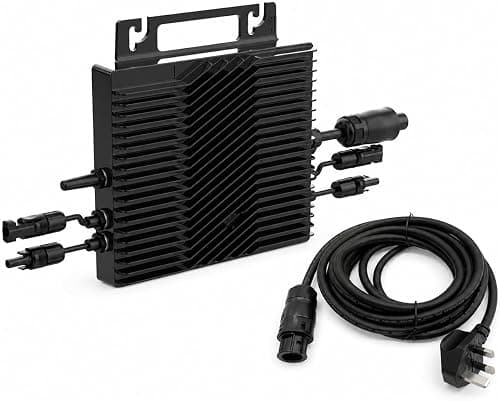
- DIY (£150–£400): a stand-alone 800 watt micro-inverter (like the Solarsys 800W at £149) paired with two second-hand or budget solar panels off Amazon or eBay. Cheapest way in for someone happy sourcing components separately.
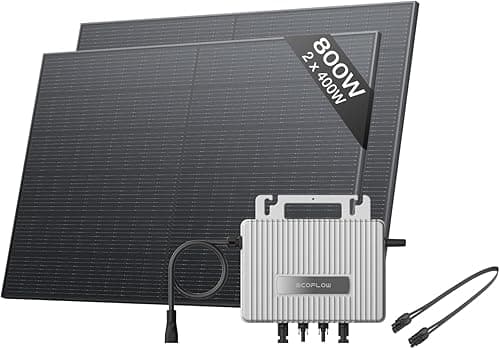
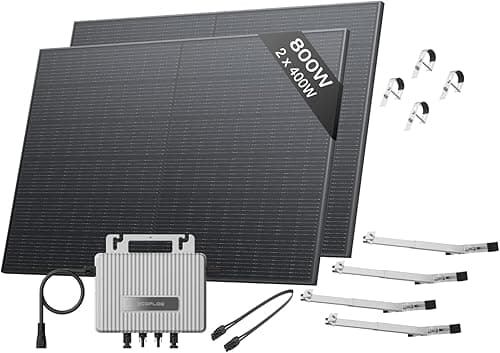
- Mid (£449–£499): the EcoFlow STREAM Balcony Solar kit — 800 watt inverter, two 400 watt panels, cables, Wi-Fi app, UK plug. Add £50 for the version with balcony rail mounts included. This is where most UK homeowners will land.
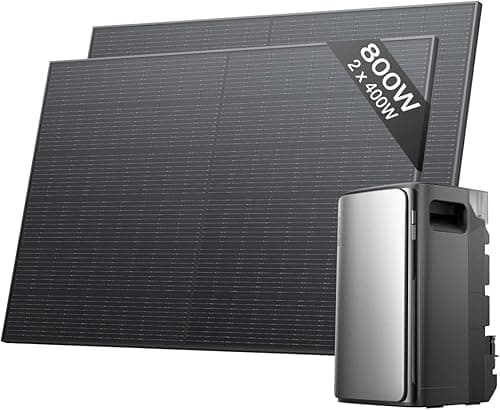
- Premium (£949 with battery): the EcoFlow STREAM Max adds a 1.92 kWh home battery to the same kit — captures the daytime solar you’d otherwise miss when you’re out of the house.
A separate portable battery (£600–£900 on top) sits outside the plug-in solar rules. The kit charges it during the day, and the battery independently powers your devices in the evening. Popular for renters who’re out during the day, less useful if someone’s already home when the sun’s shining.
How much electricity you’ll get, and how quickly it pays back
A south-facing 800 watt kit in the UK generates roughly 700 to 850 units of electricity a year — about a quarter of what an average household uses. At the mid-2026 price cap of 27p per unit, that’s £190 to £230 a year off your bill, assuming you’re at home to actually use most of what it produces. On a £600–£900 kit that’s a 3 to 5 year payback.
Two things that change the numbers:
- Which way it faces:east or west generates about 20% less over a year. North generates about 40% less and won’t pay back inside a decade — not worth doing.
- Whether you’re home during the day: plug-in kits don’t sell extra electricity back to the grid — anything you’re not using at that exact moment is just lost. Households with someone home in the day capture 80% or more of what the kit produces. Households empty in the day capture 40–50%. Even at 40%, a £600 kit still pays back inside 6 years — not bad.
Who plug-in solar is for
Plug-in solar is a genuinely new option for the ~40% of UK households that can’t install rooftop solar — renters, flat-dwellers, homes with unsuitable roofs, and owner- occupiers who don’t want the £6k+ upfront cost of a conventional install. Four clean audience segments:
- Renters— plug-in kits move with you. Balcony rail mounts don’t need drilling. Most tenancy agreements don’t explicitly cover this yet because it’s so new, but since nothing gets attached to the building itself, the usual “no permanent changes” clause isn’t a problem.
- Flat-dwellers— south or west-facing balcony? You’re exactly who this is designed for. Germany has been doing this at scale for years; it’s the norm there. Communal balconies need sign-off from your building management company; private ones usually don’t.
- Small terraces and garden studios — a plug-in kit on a sunny wall, garden studio roof, or ground- mounted frame in the garden covers the baseline of what you use. Cheap way to try solar before deciding on a full rooftop install.
- Already have rooftop solar? Add a boost — households with existing rooftop panels sometimes add an 800 watt plug-in kit facing a different direction (east or west) to smooth the generation curve over the day. Not strictly necessary, but a legal way to add capacity without touching your existing inverter.
Best kits available in the UK today
EcoFlow dominates the current UK Amazon listings for balcony solar. Anker’s Balkonkraftwerk kits are widely available in Germany but haven’t landed on Amazon UK yet. The lineup as it stands:
- EcoFlow STREAM Balcony Solar + brackets (£499): 800 watt kit, two 400 watt panels, balcony-rail mounts included, Wi-Fi app, UK plug. Best pick for most UK homes — one-click buy, warranty backed by EcoFlow UK.
- EcoFlow STREAM Max with battery (£949): Same 800 watt kit plus a 1.92 kWh home battery. Best if you’re out of the house during the day — the battery banks the daytime solar for evening use.
- Solarsys 800W micro-inverter (£149): Just the inverter. Add two budget panels (~£250) for a fully-built kit at around £400 total. Cheapest way in.
Deeper breakdown, including which kit fits which setup and the specific things to check before you buy: best plug-in solar kits UK 2026 (in depth) →
Renter? Plug-in solar for renters covers the landlord conversation, tenancy questions, and moving mid-tenancy.
Still unclear on the legal side? Is plug-in solar legal in the UK? explains what the 2026 rule change actually says.
The one-page form, step by step
You plug the kit in first, then post the form. Nobody has to approve anything — they’re just registering that the kit exists so the network model stays accurate. Steps:
- Find your network operator — enter your postcode at energynetworks.org. England and Wales are covered by UK Power Networks, Northern Powergrid, Electricity North West, National Grid Electricity Distribution, and SP Energy Networks — you get the one for your area.
- Download the notification form from their site. Most kits also ship with a pre-filled version — check the box first.
- Fill in your postcode, address, the reference number for your electricity meter (called the “MPAN” — top of your electricity bill), the model of your kit, and the date you plugged it in.
- Post within 28 days of plugging in. The network operator confirms receipt in 4 to 6 weeks. That’s the whole process — no site visit, no fee.
What’s next for plug-in solar in the UK
Two things worth watching over the next 12 months:
- Small home batteries in scope: the government has signalled it may consult on adding small batteries (under 5 units of storage) to the plug-in rules in 2027. If that lands, plug-in solar becomes materially more useful for evening use.
- Payment for extra electricity:right now plug-in kits don’t qualify for the scheme that pays you for extra electricity sold back to the grid. Ofgem (the energy regulator) has an open consultation on extending it to plug-in kits with a smart meter — would add £30 to £50 a year of income and shorten payback by 6 to 9 months.
Before you buy — the pre-survey shortcut
Even if plug-in solar is your route, a 5-minute pre-survey tells you which direction your walls and balcony face, how much shade you get, and how much sunlight your address actually receives. Useful sanity check on the payback for whatever balcony or garden mount you end up choosing.
Run our free 5-minute solar pre-survey — uses your address and satellite data to give you the numbers. It’s aimed at rooftop solar but the direction and sunlight data applies to any south-facing balcony or wall too.
Keep reading
Solar
Rooftop solar in the UK
The full route — a 4 kW system professionally installed, with the option to sell extra electricity back to the grid. Compare against plug-in on scale and payback.
Read moreCheck
Free 5-minute solar pre-survey
Rooftop-focused, but gives you the direction and sunlight numbers even if you settle on a balcony kit.
Read moreJournal
Latest UK solar + heat pump journalism
How grants shift, what the government funds, and the latest UK install trends.
Read moreSources
- IET — BS 7671:2018+A4:2026 (Wiring Regulations, 18th Edition, Amendment 4) — accessed July 2026
- GOV.UK / legislation.gov.uk — SI 2026/848 — accessed July 2026
- Energy Networks Association — G98 notification form + Type Test Register — accessed July 2026
- Ofgem — Smart Export Guarantee (SEG) — accessed July 2026
- European Commission — Photovoltaic Geographical Information System (PVGIS) — accessed July 2026