Your roof,
earning its keep.
See how many panels your roof actually fits, how much you’d generate over a year, and whether a battery pays for itself — all read straight from satellite.
- Just your address
- Satellite-read sizing
- Battery payback
- Free first check
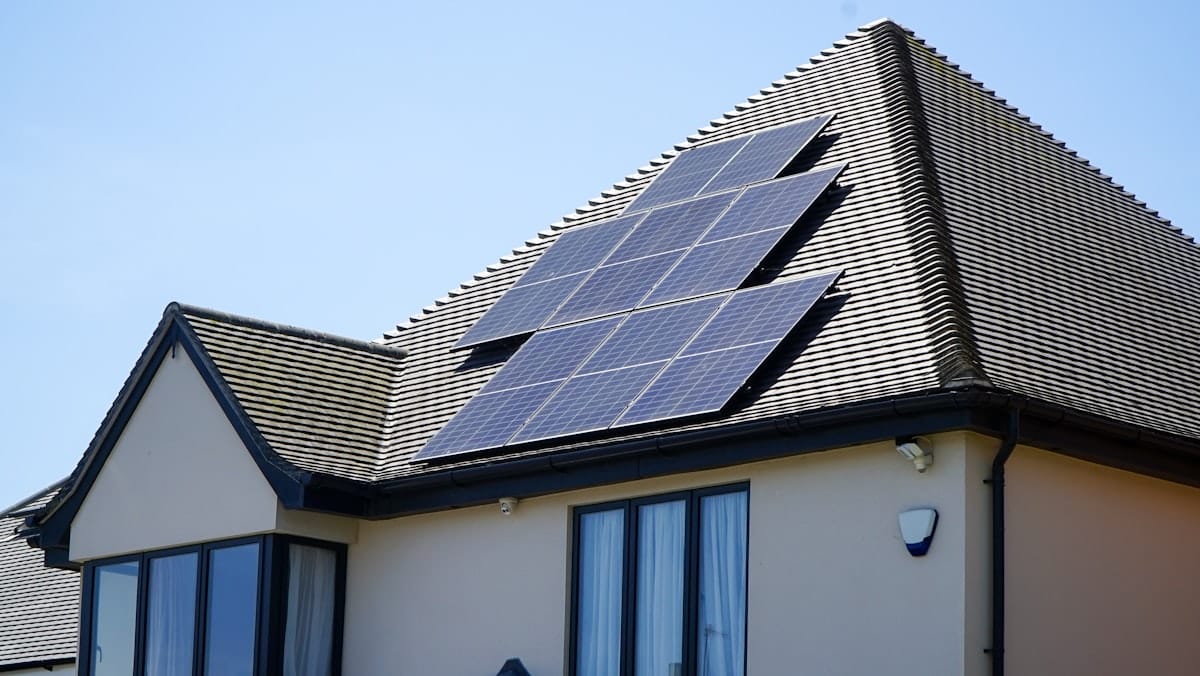
Typical UK semi
~10 panels
on a south-facing roof
Bill saving
~£500/yr
from what you use directly
What we check
Real roof numbers, not a postcode guess.
We use the same satellite imagery and sunlight data Google uses for commercial solar projects — applied to your specific roof, angle, and shading.
Roof angle, shading + direction
South-facing vs east-west, chimney shadows, nearby trees — read from your actual roof, not a postcode average.
How much electricity you'd actually get
A real yearly number based on your specific roof direction and angle — the kind of figure we'd stand behind in front of a qualified installer.
Battery payback that actually pays back
We match your evening electricity use against what your panels would generate — so you only buy the battery size that earns its money.
What you'd actually save
Against your real electricity price (or UK average if you don't have your bill handy). What you use directly vs what you sell back — kept separate so the maths is honest.
How it works
Five minutes, your address is enough.
Your address
That's it. We pull your roof from satellite, your tariff from your latest bill (optional), and your usage pattern from a couple of quick questions.
We do the modelling
Satellite imagery of your roof, official UK sunlight data, and your electricity price — all cross-checked against typical UK install standards.
A clear, quote-ready report
Number of panels, how much electricity you'd generate each year, battery size, and payback. Ready to share with any qualified installer for a real quote.
Common questions
Solar in the UK — the five things homeowners ask us most.
How much do solar panels cost for a typical UK roof?▼
A solar system for a typical UK home in 2026 costs £4,000 to £8,000 fully fitted — that's everything (panels, control box, scaffolding, paperwork). Adding a home battery brings the total to £6,500 to £10,500. Prices vary with roof complexity and access. There's no VAT on domestic solar in the UK until 2027, so the sticker price is what you pay.
How long does solar take to pay back in the UK?▼
A typical UK solar system with no battery pays back in 8 to 12 years at 2026 electricity prices — you save 27p for every unit you use directly from the panels, and get paid 3 to 15p for extra electricity sold back to the grid. Adding a battery lets you use more of what you generate and typically cuts payback to 6 to 9 years for households with electricity bills over £800 a year.
Do I need planning permission for rooftop solar?▼
For most UK homes, no — rooftop solar counts as a normal home improvement you don't need permission for, as long as the panels don't stick more than 200mm above the roof line and don't cover the highest part of the roof. Listed buildings and Conservation Areas DO need planning permission; check with your local council before you commit.
Is a home battery worth it?▼
A typical home battery adds around £3,500 to the install. It stores daytime solar for you to use in the evening, letting you use about 75% of what your panels generate instead of 35% without one. Worth it if your electricity bill is over £800 a year or you're planning an electric car — payback usually 8 to 12 years. Not worth it for low-usage homes.
Do I need a site visit to get a solar quote?▼
Not for a first quote. Propertoasty combines your address with satellite imagery of your specific roof to work out how many panels it fits, which direction each roof face points, and how much sun it actually gets over a year. A qualified installer can quote from that remotely. A visit is still needed before the install itself, to confirm fixings and cable routing.
Keep reading
The solar questions everyone lands on next.
Comparison
Solar vs no solar — is it worth it?
Real numbers on install cost, self-consumption, SEG earnings, and how long payback actually takes on a UK roof.
Read moreComparison
Solar with battery vs solar alone
When a battery earns its keep, when it doesn't — and how smart-tariff arbitrage changes the maths.
Read moreComparison
Solar PV vs solar thermal
Electricity or hot water? Which suits your roof + your household load — and why PV wins for most homes.
Read moreResearch
UK Home Energy Affordability Index 2026
Trended snapshot of UK home energy affordability across 5 lodgement years and 13 regions.
Read moreJournal
Guides + retrofit stories
Practical notes on rooftop solar, batteries, and the tariff choices that make the numbers work.
Read moreDirectory
Qualified solar installers near you
Properly qualified installers covering every UK postcode. Verified Google reviews, request a quote in 5 minutes.
Read moreSee if your roof is solar-ready.
Free first check. Five minutes — just your address and we’ll do the rest.
Start my solar checkPre-survey indication only — not a final engineering assessment.